
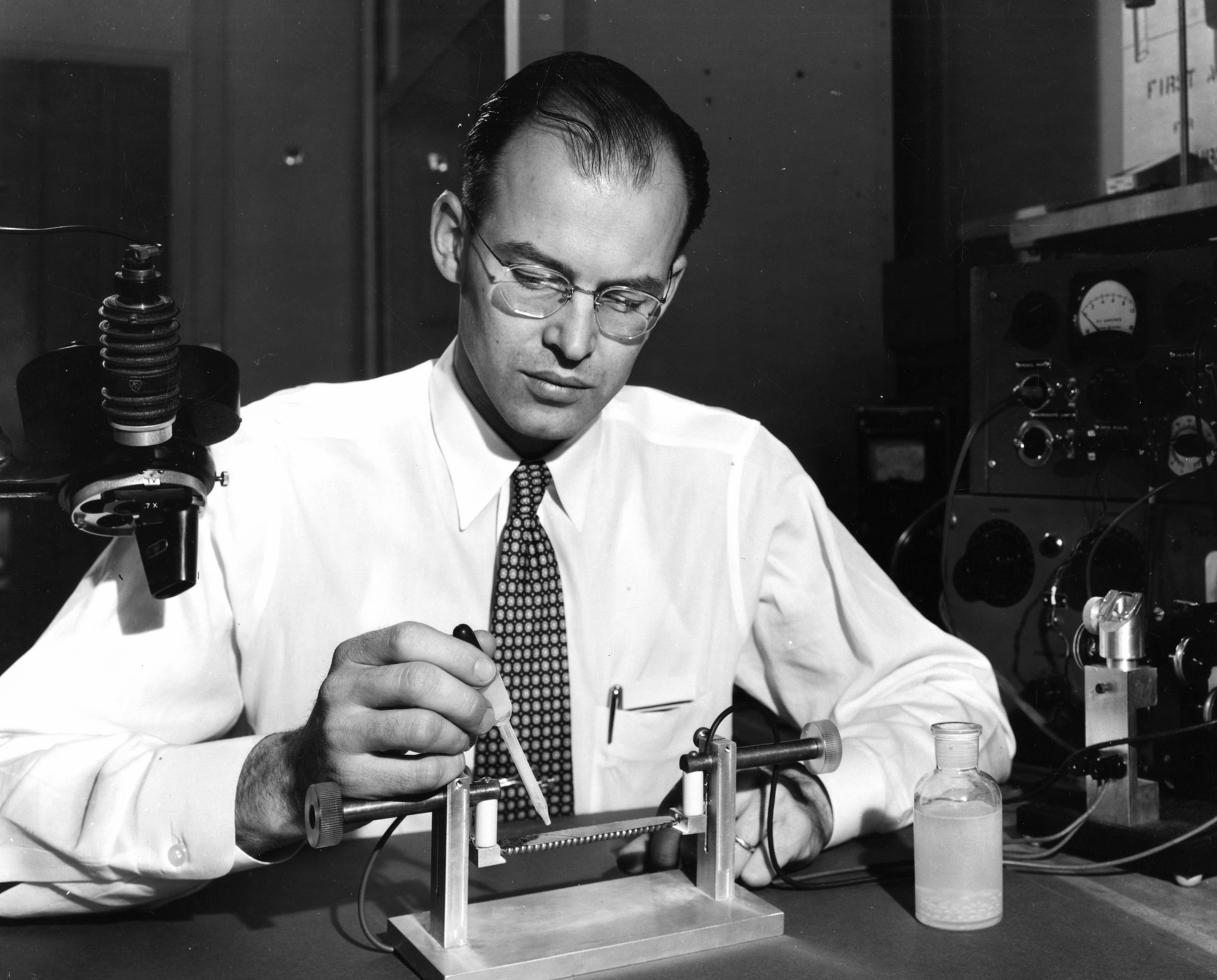
In 1962, a small yet immensely significant discovery took place that would change the future of telecommunications, medicine, and countless other industries: the invention of the semiconductor laser. The man behind this revolutionary breakthrough was Robert N. Hall, a physicist and engineer whose work in the field of semiconductor technology created a more efficient and compact laser than anything that had been possible before. This invention would go on to play a critical role in shaping modern technology, from fiber-optic communication systems to barcode scanners, optical storage devices, and beyond.
Early Life and Education: A Passion for Physics and Technology
Born in 1926 in New York, Robert N. Hall demonstrated an early interest in the sciences. He pursued this passion through his academic career, earning a degree in physics from Columbia University. He then went on to earn his Ph.D. in physics from Princeton University, where his focus shifted toward solid-state physics, the study of materials and their properties in the solid phase. This was an area that would become pivotal to his future work in lasers and semiconductor technology.
Upon completing his education, Hall joined General Electric (GE) in Schenectady, New York, in 1951, where he would spend much of his career working on advancing semiconductor materials and devices.
The Breakthrough: The Birth of the Semiconductor Laser
The story of Hall’s invention begins with a common goal in the 1950s and early 1960s: creating a more efficient laser. Lasers, at the time, were typically made using materials like ruby crystals or gas discharge tubes—which, while successful, were bulky and required a lot of power. These lasers were also quite difficult and expensive to manufacture, limiting their widespread use and practical application.
Hall’s key insight came from his work with semiconductors—materials like gallium arsenide (GaAs), which have electrical properties that can be manipulated to create efficient light-emitting diodes (LEDs). Hall recognized that semiconductors could also be used to generate coherent light through stimulated emission, the fundamental process that powers lasers.
In 1962, after years of experimentation, Hall and his team at GE developed the first semiconductor laser—also known as a laser diode. This breakthrough occurred when they successfully built a diode from gallium arsenide that emitted coherent light when an electrical current was passed through it.
This invention was revolutionary for several reasons:
- Size and Efficiency: The semiconductor laser was much smaller and more energy-efficient than previous types of lasers.
- Lower Cost: Since the laser diode was made from widely available semiconductor materials, it was far less expensive to produce than traditional gas or crystal lasers.
- Practical Applications: The small size, low power requirements, and cost-effectiveness of the semiconductor laser made it perfect for use in a wide variety of applications, from telecommunications to consumer electronics.
Hall’s semiconductor laser wasn’t just a scientific curiosity—it was a device that opened the door to a wide range of practical uses, and it became a key component of the rapidly advancing fields of optics, telecommunications, and data storage.
The Impact: A Revolution in Communications and Beyond
While Hall’s invention was initially focused on the development of efficient light sources, it quickly became clear that the semiconductor laser would have far-reaching consequences. By the late 1960s and early 1970s, Hall’s laser was being used in a number of groundbreaking applications that would shape the future of technology.
1. Telecommunications: The Foundation of Fiber-Optic Networks
One of the most important applications of the semiconductor laser was in fiber-optic communication. The semiconductor laser, being much smaller and more energy-efficient than other lasers, could be used to transmit data over long distances through fiber-optic cables—revolutionizing the way data was transmitted globally. Fiber-optic cables could carry light signals at extremely high speeds with minimal signal loss, and Hall’s semiconductor laser made it feasible to use these cables for long-distance communication.
The fiber-optic communication systems that followed Hall’s invention became the backbone of modern telecommunications, enabling the internet, video conferencing, and high-speed data transfer we rely on today. Without the small, efficient laser diode, fiber-optic systems would not have been practical or cost-effective.
2. Optical Storage: The Beginning of Digital Data Storage
Another major impact of the semiconductor laser was in the development of optical storage devices, such as CDs, DVDs, and Blu-ray discs. These discs rely on lasers to read and write data in the form of light patterns on the surface of the disc. The small, powerful semiconductor laser made it possible to create these optical storage systems, allowing for the compact storage of vast amounts of digital information in a very small space.
Without Hall’s invention, optical storage wouldn’t have been feasible, and the explosion of data storage options that followed—including the digital music revolution and video libraries on DVDs—would have been impossible.
3. Medical Applications: Lasers in Medicine
The development of the semiconductor laser also had significant applications in medicine. Laser surgery, diagnostic tools, and laser-based treatments for a variety of conditions rely on lasers that are both precise and easy to control. Hall’s invention contributed to the development of laser surgery equipment, allowing doctors to perform highly targeted surgeries, such as eye surgery for conditions like cataracts and LASIK.
The ability to use lasers for non-invasive medical procedures transformed the field of medicine, improving outcomes and reducing recovery times for countless patients.
4. Consumer Electronics: Revolutionizing Technology
In the realm of consumer electronics, the semiconductor laser found applications in laser printers, barcode scanners, DVD players, and laser pointers. The ability to create a small, reliable light source at a low cost opened the door for the mass production of these devices, which have become ubiquitous in homes, businesses, and industries worldwide.
Recognition and Legacy
Although Robert N. Hall was not awarded the Nobel Prize for his invention, his semiconductor laser has had a profound and lasting impact on the world. The invention paved the way for modern fiber-optic communication systems, optical data storage, medical lasers, and numerous other technologies that we rely on every day.
Hall’s work is widely recognized in the fields of solid-state physics and optical engineering, and his contributions have earned him numerous honors, including being inducted into the National Inventors Hall of Fame in 2007. He is often remembered for his ability to transform scientific theory into practical, real-world applications that have transformed industries.
Conclusion: A Lasting Impact on Modern Technology
Robert N. Hall’s invention of the semiconductor laser was nothing short of revolutionary. It was an innovation that not only made lasers more efficient and accessible but also paved the way for fiber-optic communication, digital storage, and medical advancements that have become integral to modern life.
As the foundation for technologies that enable high-speed internet, data storage, and medical procedures, Hall’s contribution continues to shape the world of technology today. The semiconductor laser remains one of the most important innovations in the history of modern science and engineering, and Robert N. Hall’s vision will continue to influence technological progress for years to come.